Active Vs Passive Vehicle Tracker: Understanding The Difference
A vehicle tracker is a necessity for every business and individual owning a personal vehicle or other fleet vehicles. Without it, life would become difficult, and our everyday tasks would be complex to manage. There was a time when people had no other option than relying on guesswork, maps for directions, and asking others for navigation. In today’s continuously growing world, people are using GPS trackers in their everyday lives without even knowing it. We are using it in our smartwatches, laptops, and mobile phones, which has made our lives simpler and more convenient. In the market, you’ll get different types of trackers, like active and passive trackers. Both of these are used for the same purpose, which is vehicle tracking and fleet management. But both of these types have different costs, working modes, and benefits. Therefore, it is advised to understand the difference between these two trackers before making a decision. It will help in eliminating after-purchase stress and ensure a better tracking experience.
Active Vehicle Tracker
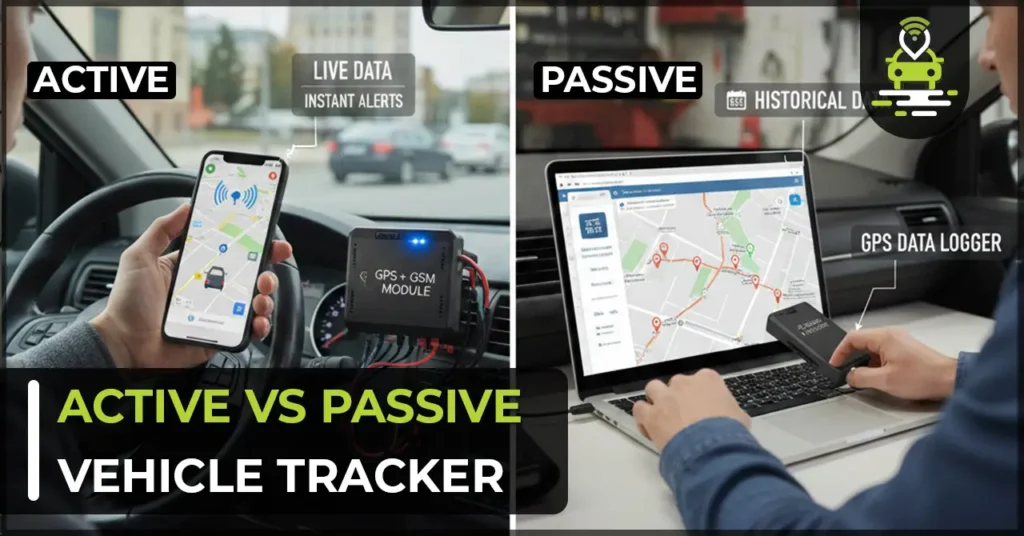
The active trackers are the one that gives real-time updates about the vehicle location, movement, and status. These devices work by giving real-time updates using a cellular or satellite network. It is a device that is designed to actively communicate with the tracking software and allow users to monitor different aspects like live location, speed, movement, status, fuel level, and route history. To determine the exact location, the device uses the GPS and also uses the GSM/4G network to transmit the data. Tracking software is also used to display the updates. Its common uses are in fleet management, logistics & delivery vehicles, rental cars, asset tracking, and more.
- Active trackers are helpful in reducing theft chances by giving instant, real-time alerts.
- It allows businesses to monitor whether drivers are adhering to their routes.
- It has the ability to create detailed reports with updated information about your vehicle’s whereabouts.
- It provides additional safety to the drivers and passengers, which gives peace of mind and enhances reliability.
- Active trackers are fast and convenient, which means they are more authentic and reliable.
- These tracking devices help in improving driving performance and help you monitor the speed and mileage.
- You can also identify the issues on time with timely alerts and monitoring fuel usage.
Active trackers are suitable for businesses that need real-time updates and instant alerts for timely decision-making. Whether you are a fleet company, logistics, assets, or any other. Active trackers keep your vehicles safe and secure. The best thing about this tracker is that it enhances customer satisfaction by allowing you to give an accurate arrival time to the clients.
Reduce Theft, Save More
Contact us for the best GPS Trackers!
Passive Vehicle Tracker
A passive tracker is the one that is fitted within your vehicle to store the fleet operational data, but does not allow access in real-time. It stores live data using a memory card or internal storage. Once the operation is completed, you can extract the data to get an insight into the location history, status, movement, and driver behavior. A data logger is another name, which means it stores data that is downloadable after the trip is completed. This data is then used by the companies to monitor different activities and identify areas of improvement.
- For those who are looking for an affordable and budget-friendly option, a passive tracker is the best recommendation.
- There is a need for any kind of subscription with these devices. You only have to pay the charges once.
- The best thing about it is that these devices use less power to operate, which means they will not drain the power of your vehicle’s battery.
- These devices are ot bound to signals because they store the data in their memory, and you can download it after the trip.
- These trackers store the data directly, are also user-friendly, and have simple functionalities.
Businesses that prioritize viewing the vehicle data and their past events can use it. If they don’t prioritize real-time data, then consider it for affordability and convenience. Passive tracking also gives the same results as active tracking, but except for real-time data.
Active Vs Passive Vehicle Tracker: The Difference
Features | Active Tracker | Passive Tracker |
Tracking Type | Real-time Tracking | Stores Data |
Data Transmission | Sends Data continuously through GSM/4G network | No live data |
Internet/SIM Requirement | Needs internet & SIM card | Don’t need live internet |
Monitoring | Live vehicle monitoring through app/web | Data can only be checked after downloading |
Alerts/Notifications | Instant alerts for speed, ignition, theft, etc. | No real-time alerts |
Route Visibility | View live route and movement | Route history is available after downloading the data |
Best For | Fleet management, logistics, security | Basic trip recording and offline tracking |
Accessibility | Remote access from anywhere | Physical access is often required to retrieve data |
Response Time | Immediate action possible | Delayed Response |
Cost | Slightly higher due to live connectivity | More affordable option |
Summing Up!
When selecting a tracker for your personal or company vehicles, it is advised to first set your goal. Ensure whether you want real-time data for live monitoring, or if you can also go with downloading the data after a fleet operation. In the market, there are different types of trackers, like active and passive. The active trackers are suitable for businesses that need live updates, multiple alerts, and real-time tracking. While the passive tracker is suitable for those who don’t prefer real-time data. They can download the data after the fleet operation and monitor it to identify the areas of improvement. It is advised to choose the trackers that meet your needs and set your goals before making a decision.
Latest Post
Do you own a personal vehicle or have a business managing multiple fleets on a daily basis? Uncertainty is the

According to a 2025 research by the anti-vehicle lifting cell, it is noted that more than 26,000 motorcycles were stolen
The advanced features of a reliable and trusted tracking system include live tracking, geofencing, route optimisation, history playback, web and mobile
Common problems in GPS tracking vary from weak or no signals, inaccurate vehicle location, and no real-time tracking, to power
In today’s world, the transportation industry is facing numerous challenges in its day-to-day fleet operations. These challenges vary from poor